
Facebook News Feed System Governance
Governing the foundational design system for over 2 billion monthly users — establishing the first-ever governance framework for News Feed and driving org-wide design consistency at global scale.
DESIGN MANAGER · DESIGN SYSTEMS · GOVERNANCE · DOCUMENTATION
2B
Monthly active users
22
Partner product teams
50%
Engineering debt reduction
70%
Faster engineering delivery

Building the team, the framework, and the culture from scratch.
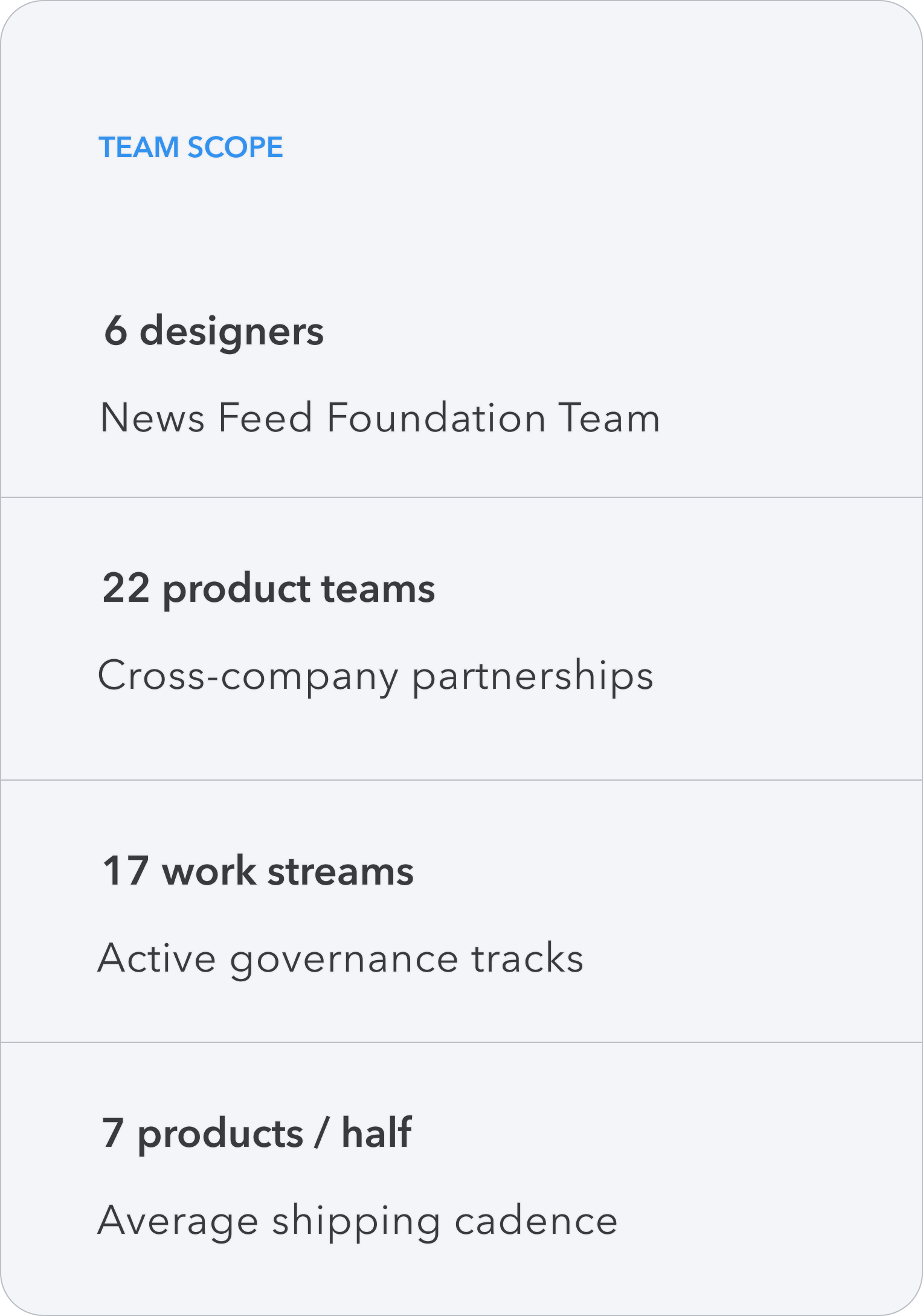
In 2020, I established and led the News Feed Foundation — a team of 6 designers responsible for architecting the design system that enables people to connect on a global scale. The goal was to drive documentation, governance, health, efficacy, and evolution of the system while ensuring a cohesive, delightful experience.
I established partnerships with 22 product teams across 17 workstreams — enabling us to ship an average of 7 products each half. I created and oversaw the News Feed's first governance process, which managed hundreds of customization requests from across the company each half.
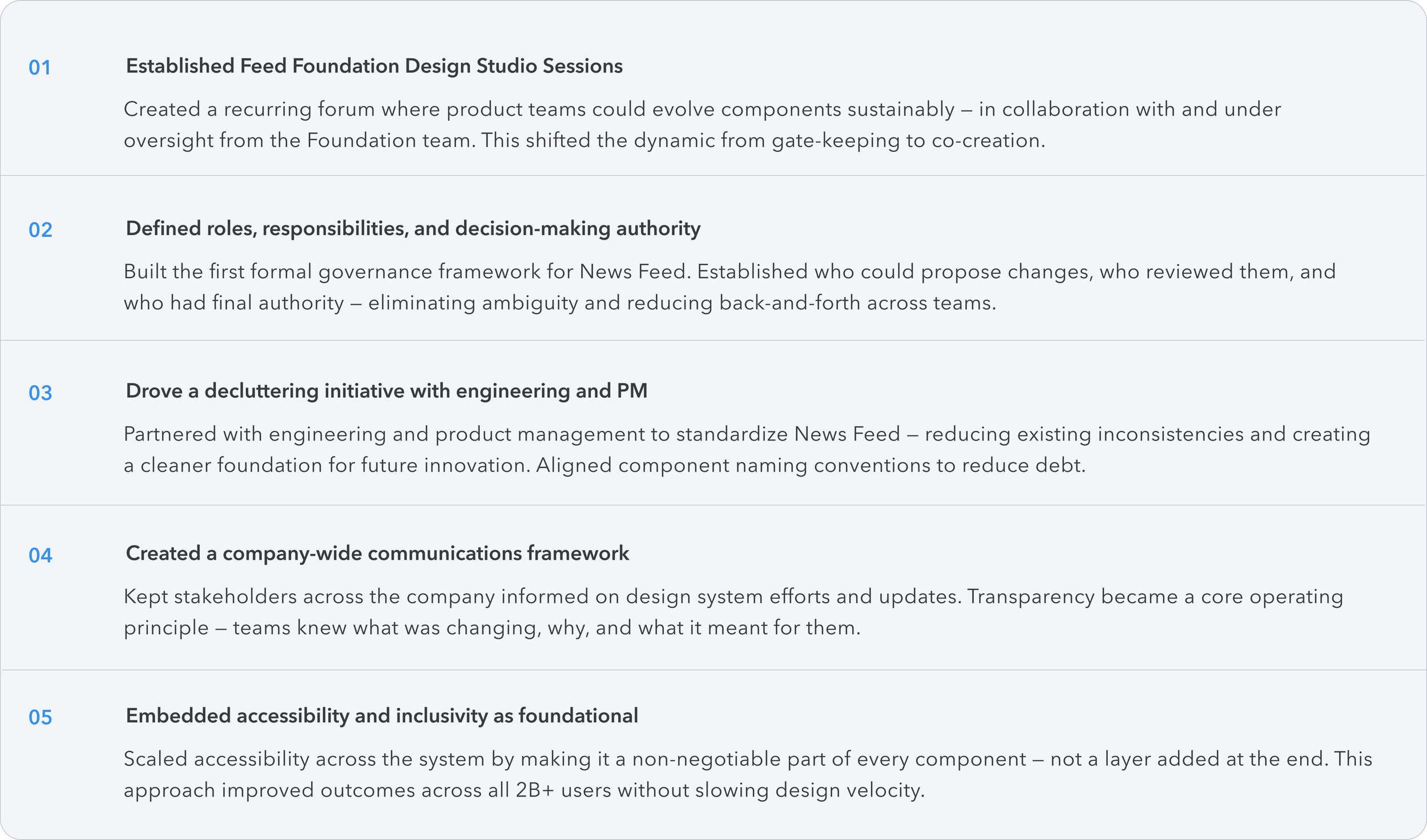
I established the governance framework, defined roles and responsibilities, and assigned decision-making authority to ensure a streamlined and transparent process.
APPROACH
Governance that felt like collaboration, not enforcement.
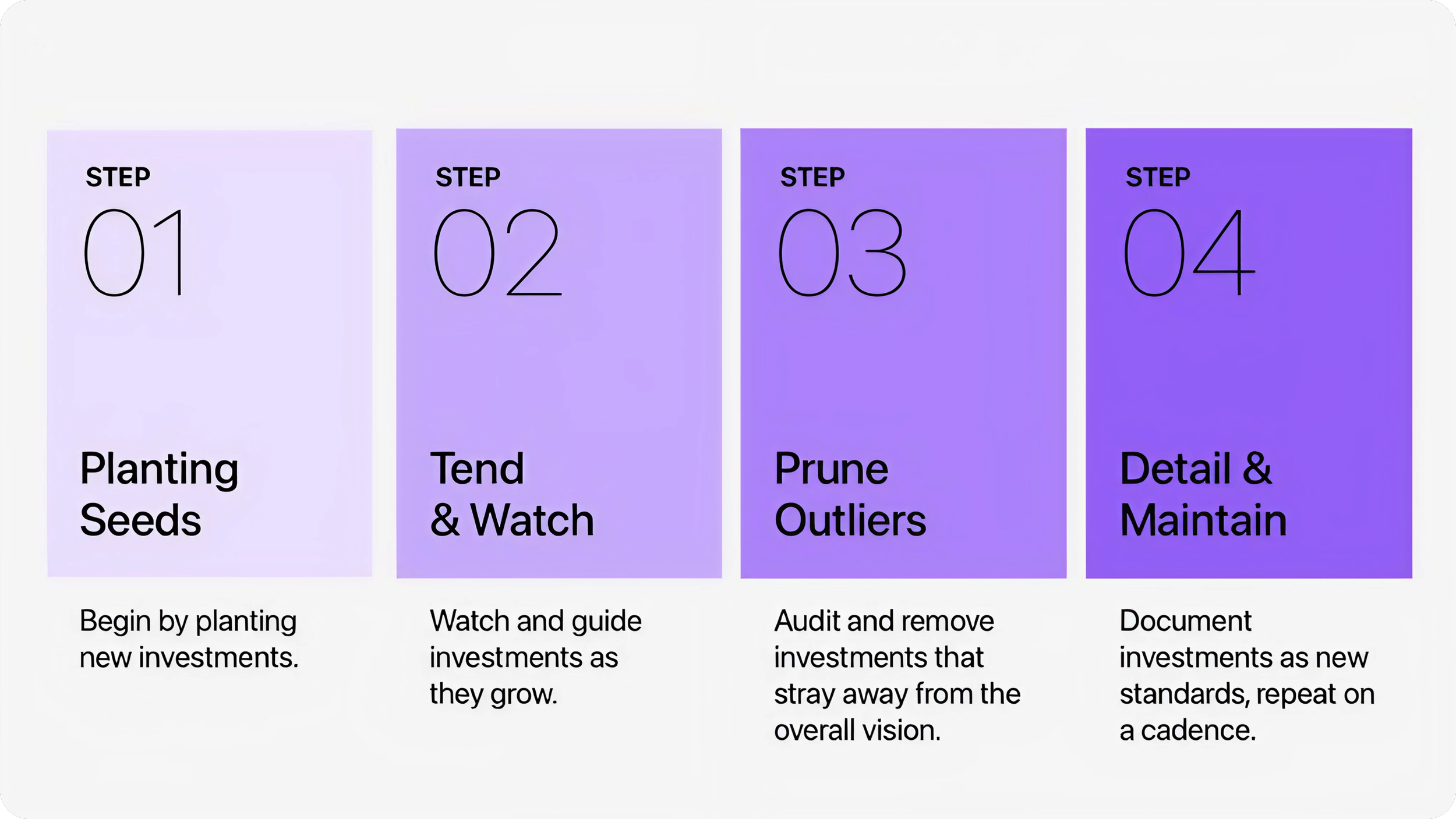
I framed the process as gardening — because a design system, like a garden, dies without ongoing tending and goes wild without pruning. That mental model shaped everything about how the Foundation team operated: we weren't here to block teams, we were here to keep the system healthy so teams could move faster inside it.
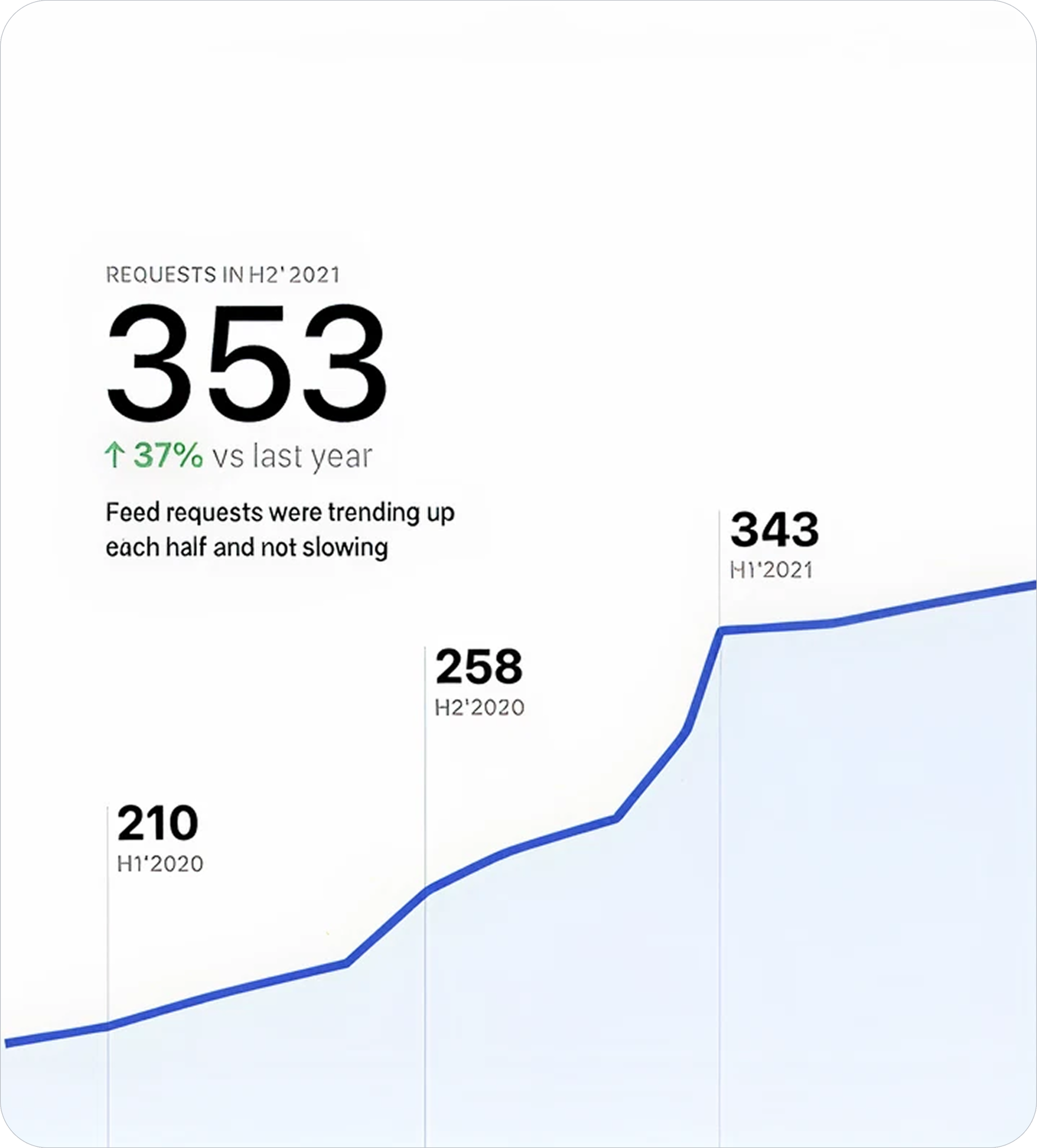
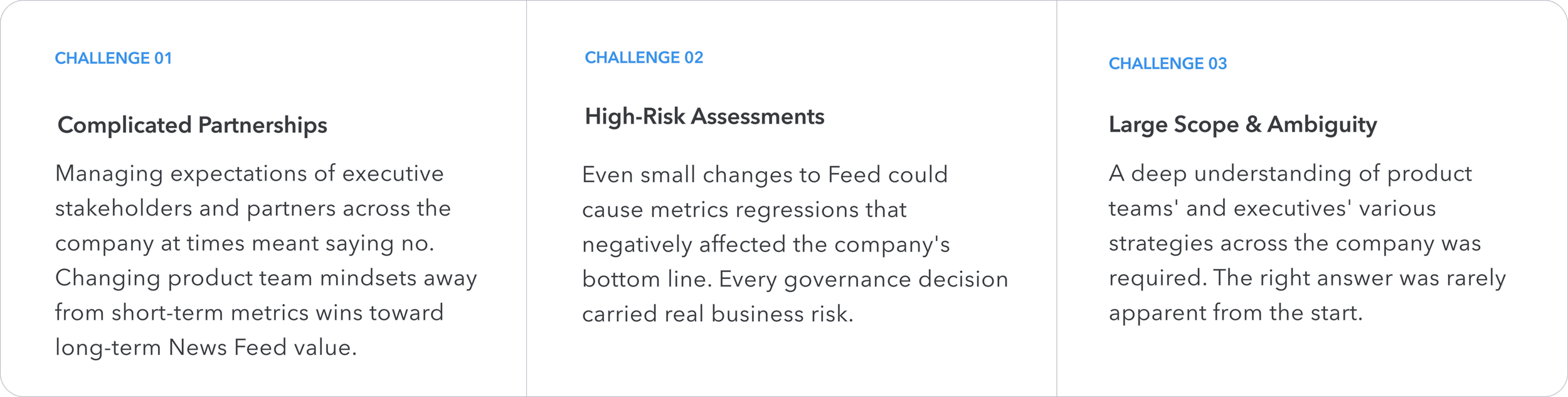
The challenge was that product teams were measured on shipping speed, not system integrity — which meant governance felt like friction to them by default. The strategic bet was to flip that dynamic: make the Foundation team so useful, so embedded in teams' workflows, and so focused on their success that working with us became easier than working around us. Once teams trusted that we were helping them hit their goals — not just protecting the system — the governance process stopped feeling like a gate and started feeling like a service.
The approach had five parts:
CONTEXT
The Facebook app had become fragmented at global scale.
The Facebook app enables over 2 billion people monthly to connect with the content and communities they care about most. Because of this, News Feed had become a prime surface for other product groups to market their own features — often at the expense of the app's consistency and ease of use.
Product teams were incentivized to ship quickly rather than maintain system integrity. The result was a slew of one-off customizations that impaired the Feed experience, eroded coherence, and created mounting engineering debt.
There was no governance. No shared framework. No single team accountable for the health of the system that powered every user's daily experience.
MY ROLE
The approach had five parts:
Documenting the system: Turning one-offs into cohesion.
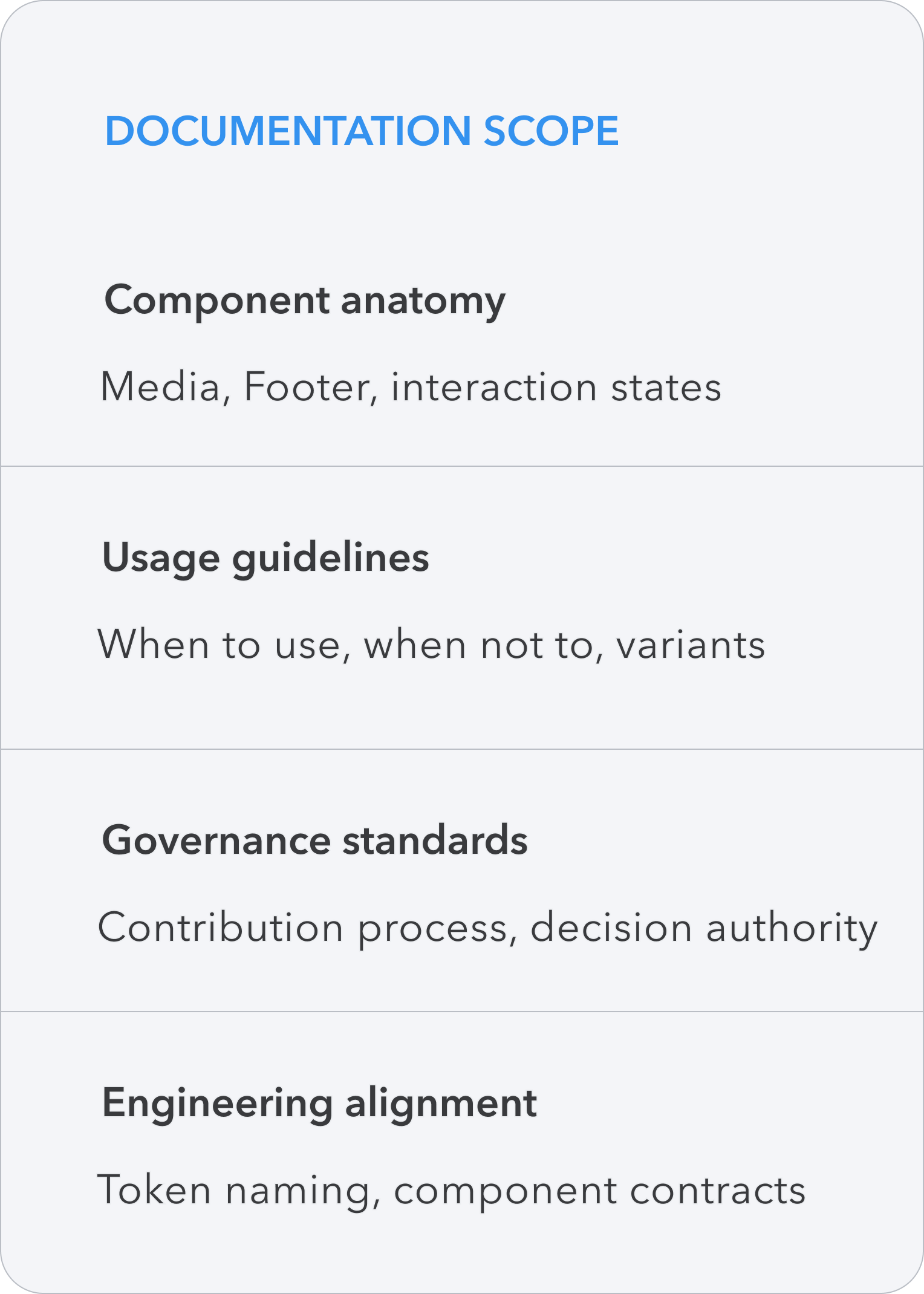
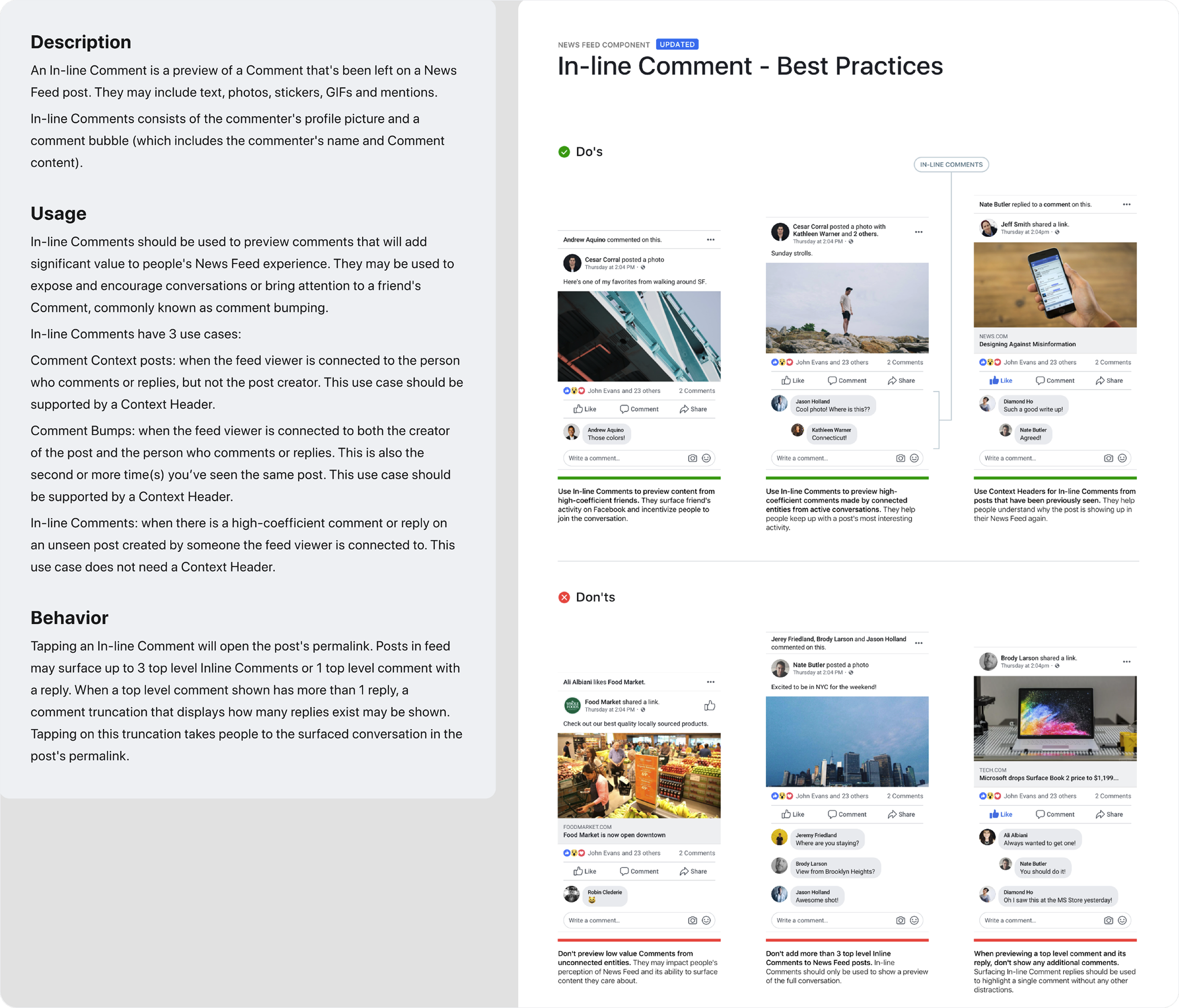
A core deliverable of the Foundation team was creating documentation that product teams could actually use — component anatomy, usage guidelines, and governance standards that made the system legible across 22 partner teams.
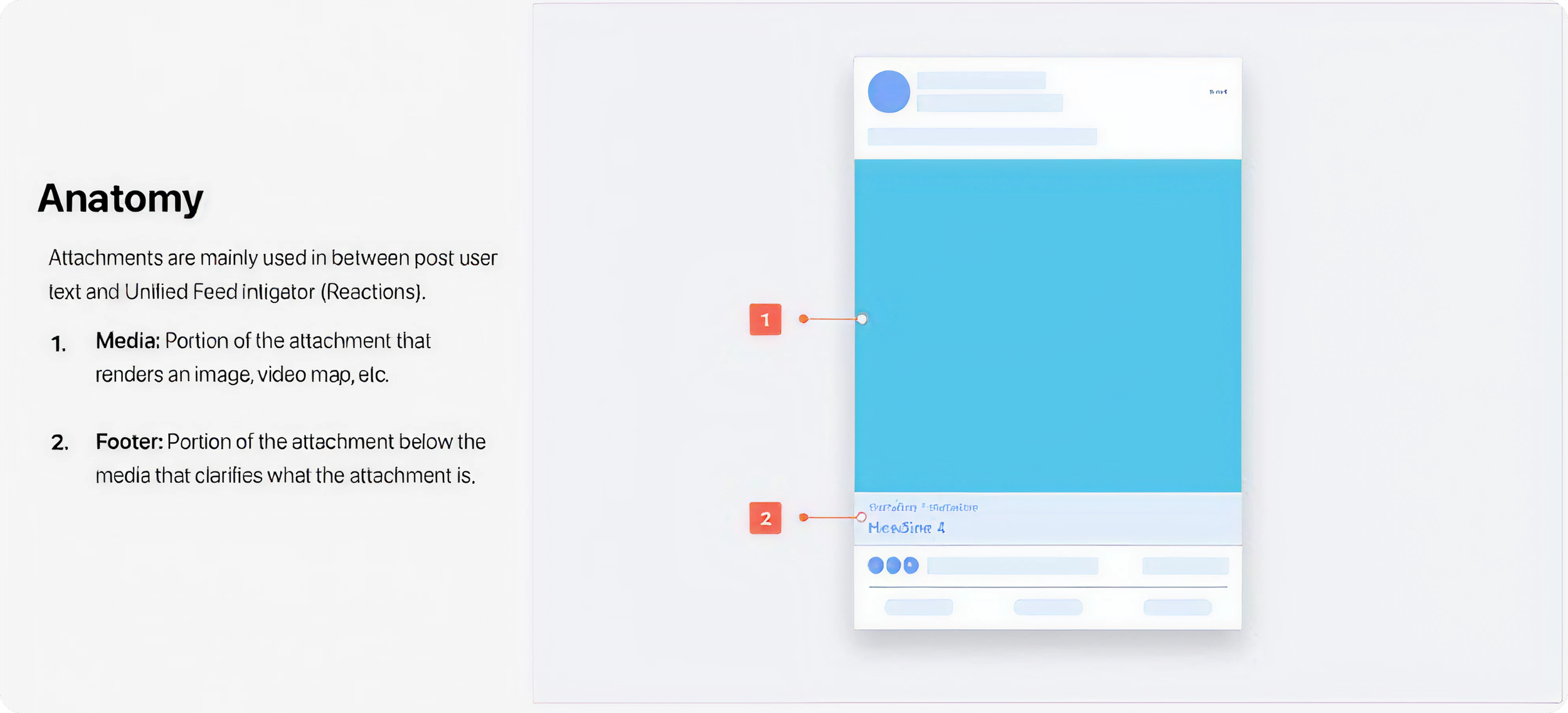
The Attachment component is one example: a deceptively complex pattern used across every surface in News Feed that had never been formally defined. Documenting it meant establishing the canonical model, aligning engineering on naming, and giving product teams a clear framework to build against rather than inventing their own.
Across one half alone, the team documented 70% of the app — accelerated by enlisting partner teams in the effort directly.
Documentation example:
DESIGN SYSTEM WORK
What decluttering the Feed actually looked like
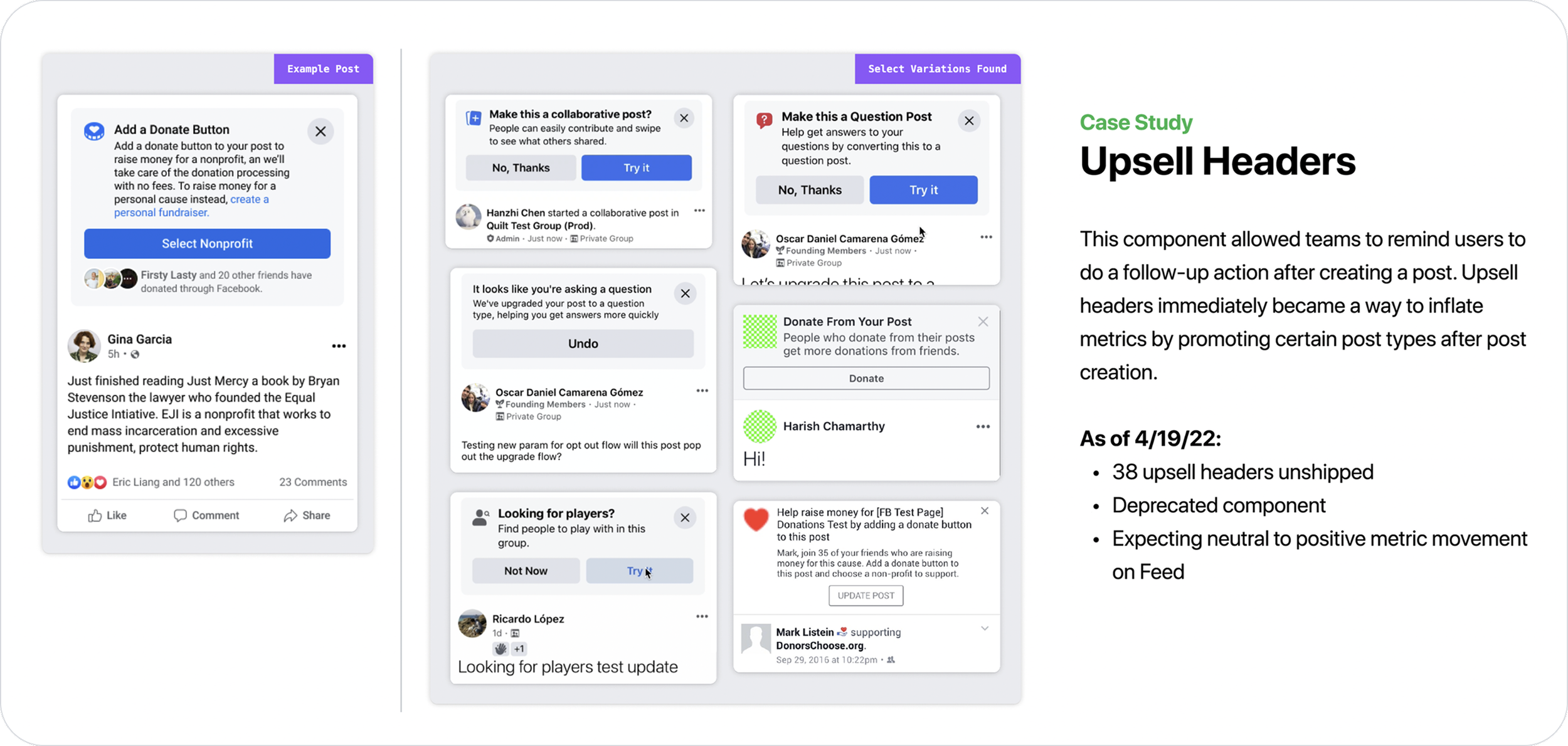
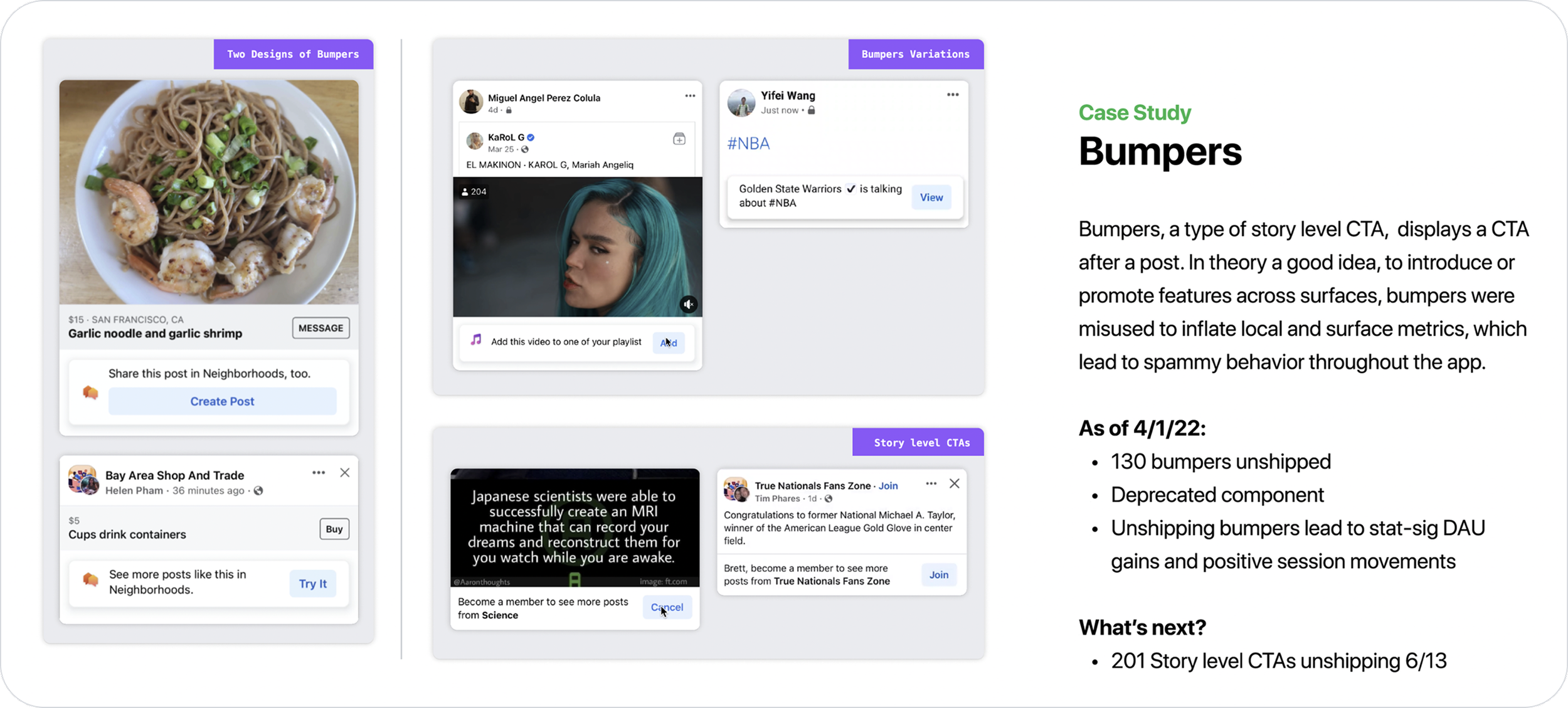
One of the Foundation team's core mandates was identifying components that teams had built to inflate local metrics — patterns that looked successful on a surface level but were fragmenting the Feed experience for users. Two examples show the governance model working at its most concrete: assessing components, building the case for deprecation, and driving the unshipping effort across partner teams.
Upsell Headers
Each vertical was a distinct information problem — different data, different user needs, different stakes. The design system had to flex to serve all of them without fragmenting into twelve separate products. Every example below shipped to production and served real users.
Bumpers
Story-level CTAs designed in theory to introduce features across surfaces — but misused by teams to drive local engagement metrics, creating spammy behavior throughout the app. The Foundation team identified 130 bumper variations and drove the deprecation. Unshipping them produced stat-significant DAU gains and positive session movement.
DESIGN SYSTEM WORK
What decluttering the Feed actually looked like
DESIGN SYSTEM WORK
What decluttering the Feed actually looked like
"The goal wasn't to say no — it was to show teams that a healthier Feed produced better outcomes for everyone, including them."
WHAT I LEARNED
Design systems scale and remove friction when governance treats internal teams as customers.
The biggest shift that unlocked everything else was treating partner teams the way you'd treat customers — with empathy, transparency, and a genuine investment in their success. That meant sharing wins publicly, making their roadmap goals our goals, and measuring ourselves by whether teams were better off working with us than without us. The moment teams felt that, the governance dynamic changed entirely. They stopped working around the system and started building with it.
Working at this scale also clarified something about accessibility: it can't be a layer you add at the end. When your system touches billions of people, inclusivity has to be structural. Once it's foundational it scales automatically; once it's an afterthought it never ships consistently.
The engineering partnership was one of the highest-leverage moves the team made. Aligning on component naming and behavior wasn't a design concession — it was a force multiplier. The 68% debt reduction and 50% improvement in delivery speed came directly from that alignment. Design leaders who treat engineering as a downstream handoff leave that leverage on the table.
Finally: documentation accelerates when you make it a shared act. Enlisting partner teams in the documentation effort didn't just speed things up — it created ownership. Teams that helped build the system were far more likely to follow it.